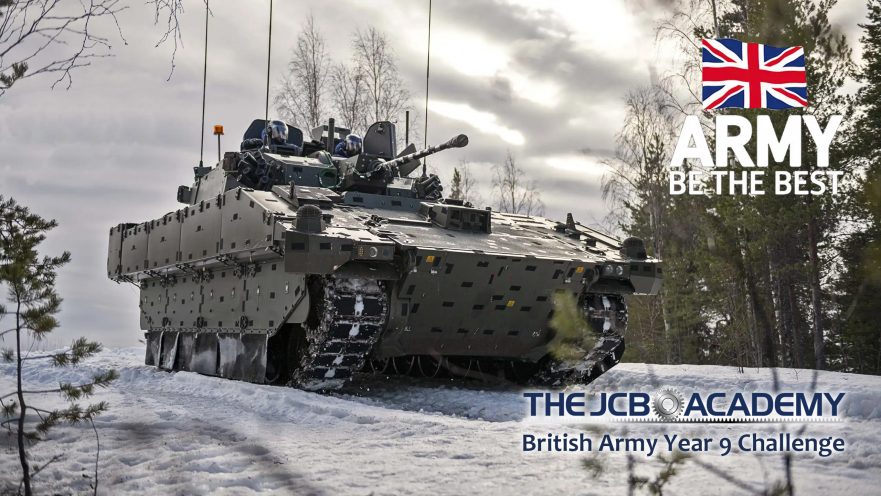
The Year 9 British Army Challenge is one of our flagship enrichment programmes, designed to immerse learners in real-world engineering, teamwork, and problem-solving. Delivered in partnership with the British Army, the challenge combines practical engineering tasks with coding, programming, automation, and communication skills, mirroring the expectations of modern engineering and defence environments.
Over several weeks, learners work in teams to complete a series of structured classroom challenges. Performance across these activities determines which teams progress to the Grand Final.
What the Challenge Develops
The challenge is designed to develop both technical capability and character. Learners are assessed on:
- Teamwork and leadership
- Communication and collaboration
- Problem-solving and logical thinking
- Coding, programming, and automation
- Planning, preparation, and reflection
These transferable skills are essential for future engineers, technicians, and business leaders.
Classroom Challenges
Each Year 9 class completes three core challenges that contribute towards qualification for the Grand Final.
Bridge Engineering Challenge
Learners work in teams to design and manufacture a bridge using limited resources. The bridge must span a defined gap and safely support the weight of a remote-controlled digger. Teams are assessed on structural stability, design quality, and how effectively they work together.
Coding and Morse Code Challenge
Using micro:bits, learners are introduced to coding and programming through Morse code communication. Teams must interpret, send, and accurately decode messages, developing an understanding of digital communication, sequencing, and logic-based problem solving.
Autonomous Drone Challenge
Each class works with its own drone. Learners programme the drone to fly an autonomous route to a designated drop zone without using a joystick. This challenge focuses on automation, precision, and planning, with teams judged on accuracy and control.
Documentation and Presentation
Throughout the challenge, learners must document their work, decisions, and learning. This evidence is used to produce an “Army on a Page” summary and a team presentation delivered to their class teacher. This reflects professional engineering practice, where clear documentation and communication are essential.
The Grand Final
One team from each class will go forward to the Grand Final.
The Grand Final brings together all elements of the challenge in a high-pressure, silent engineering task judged by British Army personnel.
Teams must:
- Drive a remote-controlled digger across their engineered bridge
- Transport a coded message
- Send and receive instructions using micro:bits
- Programme and deploy a drone to the correct drop zone
- Complete the entire task without speaking
The silent nature of the challenge places a strong emphasis on preparation, trust, and non-verbal communication. Teams are judged on technical performance, accuracy, teamwork, and professionalism.
British Army Involvement
British Army personnel support the challenge throughout, delivering engagement sessions that focus on teamwork, leadership, and communication. They also return to judge the Grand Final, providing learners with an external, real-world assessment experience.
Recognition and Experiences
Achievement in the challenge is not limited to winning teams. Learners who demonstrate exceptional attitude, leadership, or teamwork may be selected for a British Army experience day. These opportunities recognise character and commitment as well as technical skill.
Why We Run the Challenge
The Year 9 British Army Engineering Challenge gives learners access to experiences that go far beyond a typical classroom environment. It reflects our commitment to employer-informed learning and supports our mission of Changing lives by developing the engineers and business leaders of the future.
The challenge encourages learners to think creatively, work collaboratively, and apply engineering principles in realistic and demanding scenarios, preparing them for future study, apprenticeships, and careers in engineering, technology, and business.